Even though they are two different things, you will find that in the search for “conversational AI vs voice AI,” they are used interchangeably. Voice AI is a subset of conversational AI, which has to be understood and responded to in human language. Businesses are making rapid strides on this front, predicting that by 2026, one in every 10 customer service interactions will be handled by conversational AI. This blog will clarify the differences between conversational AI vs voice AI without getting bogged down in jargon and help you figure out which one is right for your business.
What Is Voice AI, and How Does It Actually Work?
Voice AI is the technology that enables machines to listen, comprehend, and respond to voice commands. It operates on three basic layers: speech-to-text, natural language understanding, and text-to-speech.
The Voice AI Pipeline, Step by Step
Voice AI can be compared to the “ears and mouth” of an automated system. It can listen, understand, and respond in real time, similar to a human agent, and does not simply read pre-recorded messages. That’s the reason many are thrown off by the conversational AI vs voice AI comparison: without the conversational engine beneath it, you can’t have voice AI.
Why Timing Matters More in Voice Than in Text
In voice, there is a time issue that exists. A couple of seconds is a pause that is barely noticed by a user. If it takes the same two seconds for a voice AI system to hesitate, then it’s a broken system because there’s no one on the other end. One of the most practical differentiators while assessing a vendor’s conversational AI vs voice AI is this latency difference.
What Is Conversational AI, and Why Is It the Bigger Category?
Overarching umbrella technology is conversational AI. It includes any system, voice, text, chat, or messaging application that can converse back and forth with another person and comprehend what it means between exchanges. The conversational AI engine is the same; just the channel that it operates through changes. The beginning of nearly all conversational AI vs voice AI comparisons you’ll find online.
Where Conversational AI Runs Without Any Voice at All
This is the biggest point of confusion in the conversational AI vs voice AI conversation. No, conversational AI doesn’t require a voice interface, and as long as it carries context, understands intent, and produces relevant responses in a multi-step conversation, it is still “conversational. It can be used in a chat widget, email triage, and a WhatsApp bot – and it doesn’t require any work by the business with speech technology.
When the Voice Layer Gets Added
As soon as a phone channel enters that mix, the conversational AI vs voice AI debate becomes real, and the same engine requires a speech layer to be implemented on a phone call.
Conversational AI vs Voice AI: The Core Differences at a Glance
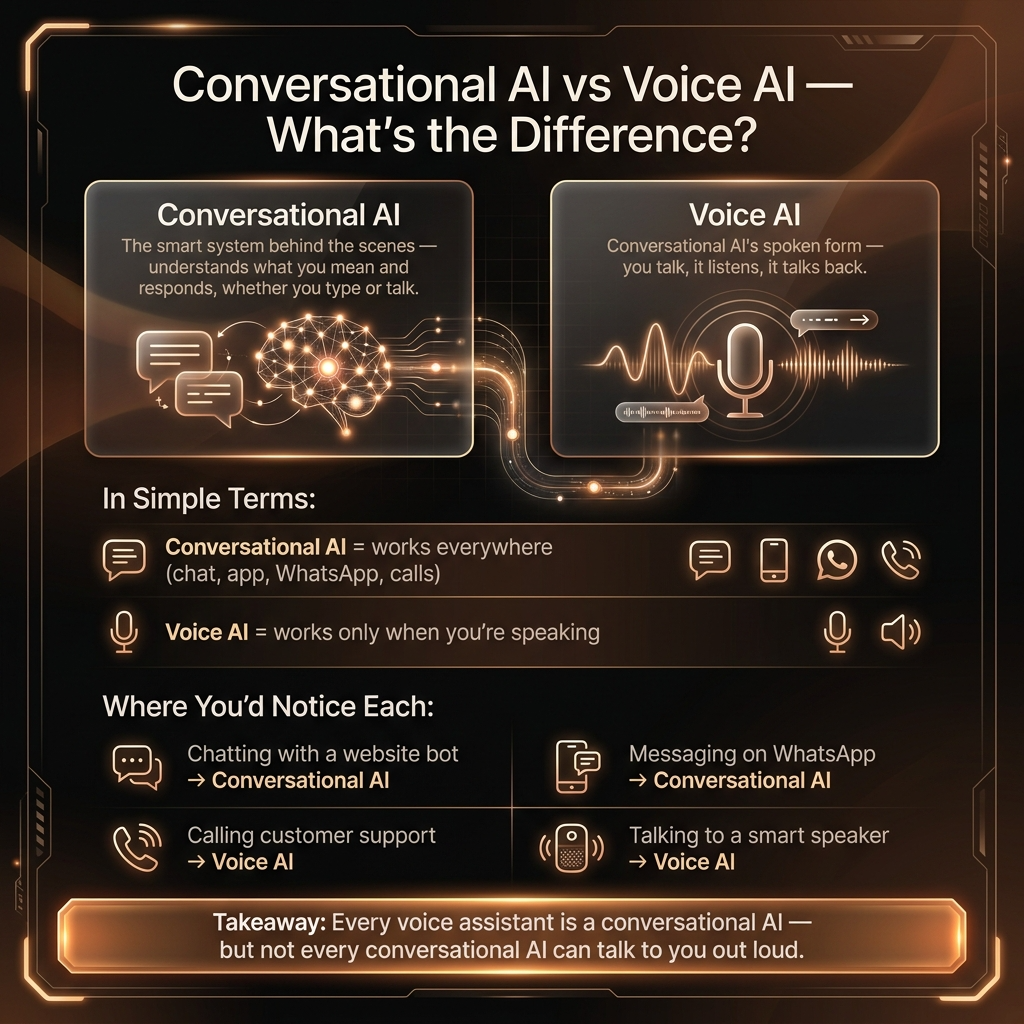
Here’s the simplest way to separate the two:
- Conversational AI is the “brain.” It handles intent recognition, context memory, and response generation, regardless of channel.
- Voice AI is the “voice.” It’s conversational AI wrapped in a speech layer: speech-to-text going in, text-to-speech coming out.
Conversational AI vs Voice AI Comparison Table
| Aspect | Conversational AI | Voice AI |
| Scope | Broad: chat, voice, messaging | Narrow: speech only |
| Interface | Text, voice, or both | Spoken audio |
| Core tech | NLU, dialogue management, LLMs | STT, NLU, TTS |
| Latency sensitivity | Moderate | High, since pauses feel unnatural |
| Typical channels | Website, app, WhatsApp, phone | Calls, smart speakers, IVR replacement |
While all voice AI systems are conversational AI systems, not all conversational AI systems are voice. That single point will likely resolve most of the queries people are looking for when they Google conversational AI vs voice AI, and it is the purest beginning for any conversational AI vs voice AI comparison.
Voice AI vs Chatbot: How Do They Actually Compare?
With both operating on similar models, the voice AI vs chatbot conundrum is often asked. The actual difference is in the input/output mode. A chatbot reads and writes text; it is asynchronous, and users need not stay put and won’t lose anything if they leave it and come back. Voice AI speaks and listens in real time and is capable of handling voice interruptions, performance, tone, and pacing that a chatbot couldn’t possibly anticipate.
Cost and Deployment Differences Between Voice AI and Chatbots
Chatbots are more cost-effective and scalable as they do not require speech recognition. While more engineering work, voice AI can be employed when typing cannot be done, such as when driving, on the call, or when the customer prefers to talk rather than type. Framed this way, conversational AI vs voice AI vs chatbot isn’t three separate technologies. One engine, three interfaces: each one appropriate for a different stage of the customer journey.
AI Voice Assistant vs Conversational AI: Are They the Same Thing?
Not quite. The comparison between an AI voice assistant and conversational AI can also be confusing, as voice assistants, such as smart speakers or in-car voice assistants, are a product that is leveraging conversational AI. The assistant is the product that the consumer interacts with, while conversational AI is the central nervous system, managing the understanding of what the consumer says and the logic for responses.
Where Voice Assistants Fit Into the Bigger Picture
All voice assistants rely on conversational AI, and conversational AI is used in other applications that aren’t assistants: for instance, in backend automation, ticket triage, or analysing consumer messages. Another perspective on the conversational AI vs voice AI dynamic: the assistant is the product; conversational AI is the invisible reasoner.
What Are the Top Voice AI Use Cases in India?
The demand for multilingual automation and the volume of calls in the customer service sector have made India one of the fastest-growing markets for voice-based automation. The demand for voice AI use cases India is largely paralleled by the trend in conversational AI vs voice AI search as enterprises phase out traditional call centers and switch to systems that interpret local vernacular.
Industry-wise Voice AI Use Cases in India
- Banking and insurance: Balance Checks, KYC verification, and policy renewal reminders
- Order status, rescheduling deliveries, and confirming COD for e-commerce and logistics. E-commerce/logistics: Order status, delivery rescheduling, and COD confirmations.
- Telecom: Optimize upgrades and resolve complaints across the board.
Why Language Flexibility Drives Adoption
What is common among all these use cases is the flexibility of the language (Hindi, English, and regional languages AI in the same call flow), which legacy phone systems were never designed to accommodate. The regional requirement is also the reason why an Indian business that considers conversational AI vs voice AI ultimately requires two layers – the conversational engine, which recognizes local languages, and the voice interface, which takes the same understanding to a live call.
Voice AI vs IVR: What Sets Them Apart?
This comparison confuses businesses still running legacy phone systems.
How Traditional IVR Actually Works
Interactive Voice Response (IVR) is the traditional method of routing people into a rigid process such as a menu: “Press 1 for billing, Press 2 for support. It only responds to keys or only a limited number of ore-programmed phrases, which is the first step in any voice AI vs IVR debate.
How Voice AI Handles the Same Problem Differently
The flexibility comes down to Voice AI vs IVR. Voice AI allows a caller to just say what they want, like “I want to check my order status,” and the AI understands it and routes it appropriately, rather than forcing them to navigate through a menu tree. The key difference between IVR and conversational AI is that the former operates on a pre-recorded script, whereas the latter responds to the caller’s words.
Cost and Maintenance: The Hidden Side of Voice AI vs IVR
Every time a business adds a new line of products or a new support product, an IVR tree must be rebuilt, and each additional branch will lengthen the menu and make it more frustrating for customers. Contact centers now consider conversational AI vs voice AI options, as the former can comprehend new intents without adding additional layers to the keypad.
What Mistakes Do Businesses Make in the Conversational AI vs Voice AI Decision?
Even skilled teams get this comparison wrong in predictable ways.
Mistake 1: Treating Voice and Text as Separate Projects
A frequent misstep in the conversational AI vs voice AI deployment is to believe that there are two channels to be managed: one for voice and one for text. In fact, intent models, knowledge base, and escalation rules can be passed on to both channels, with the exception of the interface layer. If they’re treated as separate projects, they will be worked on twice and yield different results.
Mistake 2: Skipping Text Validation and Ignoring Infrastructure Too Late
Other errors include entering into voice without first establishing conversational logic. If the dialogue isn’t as strong, then Voice AI will make it even more jarring when spoken, as it does when you read it on a screen. Testing the conversational AI layer on top of text identifies these gaps earlier and at a lower cost. One common pitfall is the lack of infrastructure input late in the project: the choice between conversational AI vs voice AI is about the technical stack, the telephony needs, and maintenance – so get both business and technical people involved early.
Conclusion
There’s no right or wrong answer when deciding between conversational AI vs voice AI. It’s about knowing which layer you are having your problem solved. Conversational AI is the umbrella term for the system that handles understanding, context, and response generation for any channel. Voice AI is the same intelligence but used in speech, whether it be a phone call, a smart speaker, or an IVR replacement. For businesses, it’s not about the technology; it’s about the medium of choice that customers are using: text, voice, or both. The successful companies will be those pairing the right technology with the right interaction, not following the latest trend- conversational AI vs voice AI adoption; banking, healthcare, and e-commerce will be the drivers of the winners.
Frequently Asked Questions
Is voice AI the same as conversational AI?
No. Voice AI is a part of conversational AI, which is based on speech. Conversational AI is the umbrella term for any AI that can handle text, chat, and messaging, both with and without voice, when compared to voice AI.
What is the main difference between conversational AI vs voice AI?
Conversational AI is the technology behind what makes it possible to understand and create language on all channels. The short answer to conversational AI vs voice AI is that voice AI adds speech-to-text and text-to-speech.
Is conversational AI better than IVR for customer service?
For most businesses, yes. Conversational AI understands natural language and adapts to varied requests, while IVR only follows rigid, pre-set menu paths that frustrate callers with complex needs.
Can voice AI understand regional languages and accents?
Voice AI systems today have become more and more multilingual and regional, particularly in the Indian market, but with varying levels of accuracy depending on the provider and background noise.