
Conversational AI is the technology that powers chatbots and voice assistants that can communicate with human-like speech and interpret human language. For businesses, this technology has evolved from a mere add-on to a core part of daily customer service, IT support, and business operations. The hard part isn’t whether you should use it; it’s which platform best fits your stack, compliance requirements, and growth plans. This guide outlines what conversational AI is, why it’s still in high demand for enterprises, what needs to be included in a platform comparison, and how to conduct a proper vendor evaluation before signing on the dotted line.
What Is Conversational AI, Really?
Put aside all the marketing jargon, and conversational AI is a system that uses natural language processing (NLP), machine learning, and dialogue management to interact, or speak, with users, and then to take meaningful action based on what it hears. Today’s AI-powered chatbots are more than just decision trees. They can retrieve data from the CRM, set up a workflow in an ERP, escalate to a human agent with full context, and be sharper over time by learning from each interaction.
There’s a simple difference for the buyers, and that’s that a chatbot answers questions from a pre-made list and stops when a buyer asks a question that is not quite the same as what the script author was thinking. A genuine conversational AI assistant will know what people want, remember what they’ve said in the previous turn, and respond accordingly to the who and what-why of the questioner. The difference is what makes the difference between using a tool and needing to use a tool, and it’s typically apparent after about 5 minutes of using a platform with real and troublesome customer language, instead of a scripted demo.
This is another area where many purchasers go wrong in buying. A marketing page is often used the word “AI-powered” more loosely, and the same is true of a platform; it might look advanced at the landing page, but have brittle logic under the hood. One of the quickest ways to distinguish a real natural language understanding system from a “well-dressed” decision tree is to ask a vendor to explain what they do when confronted with a question that is outside of script.
Why Are Enterprises Investing in Conversational AI Right Now?
The transition is not due to hype; it is cost- and experience-based. Gartner estimates that the use of conversational AI in contact centers will save agents $80 billion by 2026, without impacting service quality, since more routine interactions will be automated (source linked below). That’s a number that’s tough to turn a blind eye to for any business with a big support group.
However, there are a couple of factors that are driving adoption further:
- The expectations of customers have been changing. Users are not willing to wait in a line and are expecting a quick response with a precise answer, no matter the time of day.
- There were greater hiring pressures for support and IT workers, leading to a need to automate first-line interactions instead of continuing to hire at the same rate.
- Conversational AI is now a whole lot better, not only at matching keywords, but also at grasping nuance with Generative AI.
- Integration ecosystems have become more developed; today’s platforms do not require as much custom integration work as previous years when they were more immature.
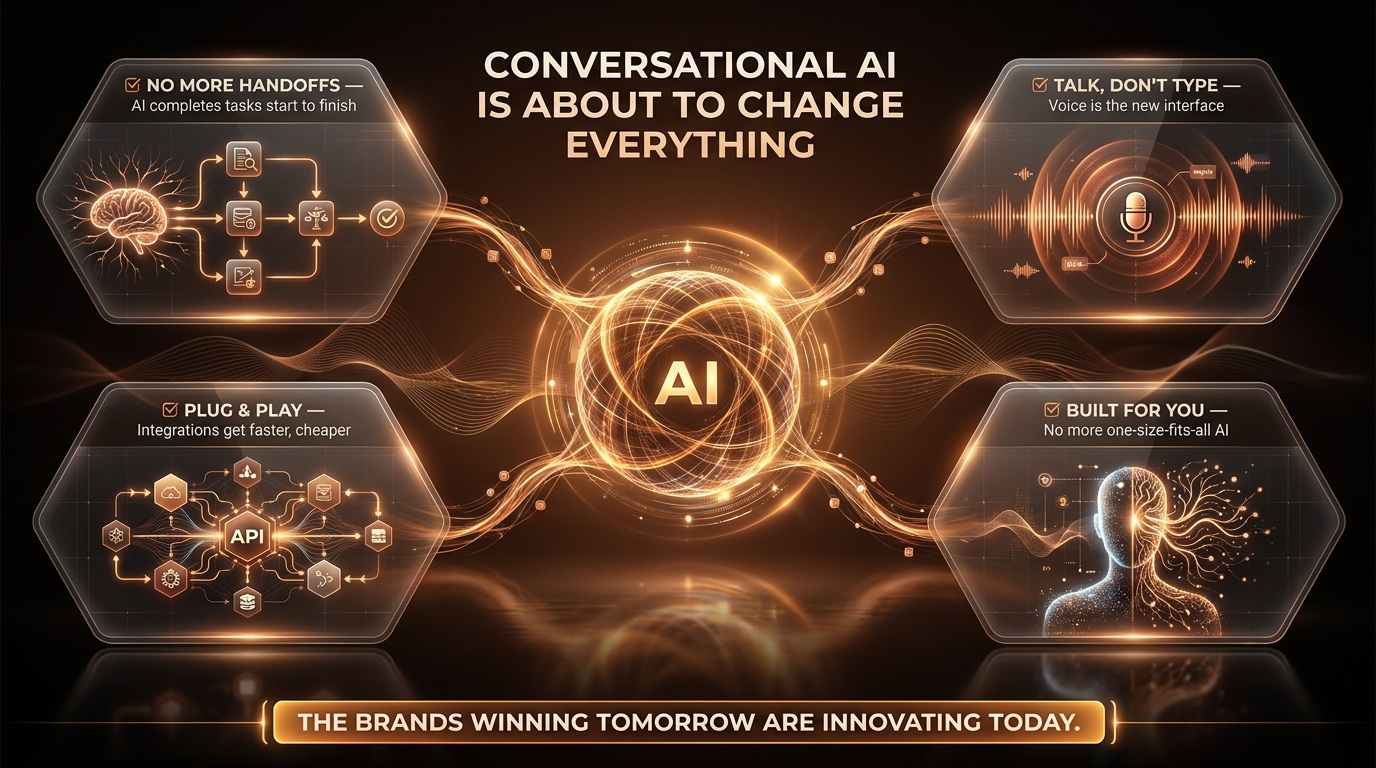
It’s not only about deflecting support tickets with Enterprise conversational AI. It is being deployed for employee induction, IT helpdesk automation, sales qualification, and even as an in-house knowledge search across multiple languages, wherever a natural-language interface trumps navigating menus or documentation. This wider context is the very reason why the purchase has become more complex than ever – not simpler.
Imagine a medium-size insurance provider receiving thousands of inquiries about the status of insurance policies every week. With a thoughtful implementation of a conversational AI assistant, you can retrieve the policy record, respond to Customer inquiries regarding status, and only pass over the handful of cases requiring a licensed agent to the rest, which can be handled by the AI. It’s not about the novelty of the chatbot on the website; it is about that kind of outcome that is driving budget approvals.
What Should You Look for in an Enterprise Chatbot Platform Comparison?
Not all platforms are enterprise-ready, and an enterprise chatbot platform comparison must extend beyond a pretty presentation of the sales demo. The difference between the scalers and the stalls after month three:
- Ambiguous phrases and slang, multi-intent: can it handle it well, or does it return “I didn’t understand that” too much?
- Omnichannel Support: Is it the same for every channel used—such as web chat, voice, WhatsApp, SMS, and in-app messaging—or is each channel a different build and has its own quirks?
- Security and Compliance: If you’re in a regulated industry, you need to ensure that the cloud provider has SOC 2, GDPR, and HIPAA compliance, not a nice-to-have.
- Post-launch analytics and reporting: Is it possible to view containment rate, escalation triggers, or sentiment trends…or did you launch blind and get caught up in the weeds?
- Customization without a lot of engineering: If something changes within the business, then the flow or response should be able to be updated without having to open a ticket with IT.
- Scalability: Will the platform scale during times of heavy traffic while maintaining response time and accuracy?
These criteria can be run next to each other on paper before a single sales call is made, and that way, they will remain objective and not influenced by the smoothest-looking demo. Another benefit of scoring each vendor against the top 3 use cases is that the platform that is great at IT help-desk automation doesn’t necessarily perform well with high-volume customer support, and that only becomes clear once you compare it to your workflows.
How Do You Run a Conversational AI Vendor Evaluation?
Where most of the buying decisions go wrong, inappropriately, not because the wrong vendor is selected, is a conversational AI vendor evaluation that was too superficial to detect issues that only emerge 6 months after launch. An evaluation should include:
- Proving concepts using your own data. Related demos are impressive, but they don’t show you how the platform will work with your product catalog, support tickets, or internal documentation.
- Total cost of ownership (TCO). Take into account implementation, per-conversation pricing, maintenance, and the cost of continuous model tuning—apart from the license fee in the contract.
- Roadmap and cadence of Vendor updates. Conversational AI is moving quickly, and you don’t want the vendor to be doing the same but be shipping a two-year-old model.
- Use industry language for reference customers. The language and rules of compliance for healthcare or financial services are more complex and may not be a platform’s strength.
- Support and SLAs. What do you do when the system misfires in production at 2 a.m., and how quickly does someone respond to the misfire?
Do not take this step lightly; it is not a routine or formality. One of the most common culprits of a business’s business case falling short of expectations in enterprise rollouts is a rushed conversational AI vendor evaluation.
What Are the Biggest Challenges in Conversational AI Integration?
The best platform is only as good as its conversational AI integration, as adding it at the end of a project is merely an afterthought. The most frequent conflicts are:
- Data Sources are Scattered: AI answers will always be disparate regardless of the quality of the underlying model when customer or product data resides in five separate systems.
- Legacy System Integration : Legacy CRMs and ticketing systems might not have current APIs, which means teams are required to build their own middleware to be able to integrate the two.
- Change Management : Train change agents and IT to collaborate with the AI, not against it; no other obstacle stifles adoption more than resistance from front-line teams.
- Losing Context Through Handoffs: Customers lose context when a bot passes off to a human, which leads to customer frustration and a typical loss of efficiency as a result of the deployment.
This is what makes the difference between an AI pilot and a system that enterprises trust for their production use. Successful integration typically involves a gradual process – begin by using a small subset of customers with high volume, show the value, then gradually add more use cases. Businesses that don’t go through this stage are often wasting their time the first year working on issues that could have been prevented by the staging.
The following checklist is helpful before allocating engineering effort: Outline all systems the assistant needs to access and all systems the assistant needs to update, and identify whether they have well-documented, clean APIs. For custom connectors, if more than a couple are needed, allow additional time, and you need to have a technical owner who owns the entire go-live process; it is typically treated as a side task that delays the go-live date by months.
What Should a Conversational AI Buying Guide Cover?
A conversational AI buying guide should align more closely with your business objectives than simply a list of features from a vendor’s website. Before assessing the conversational AI vendors, ensure that you have internal buy-in on:
- Application Area: Deflection of customer support, internal IT help-desk, sales support, or a combination of all three, prioritized.
- Model Pricing: Platform licensing, per-conversation licensing, or per-seat licensing, which has an impact on overall cost based on use.
- Data residency and privacy regulation: Particularly important for healthcare, financial, and government-related sectors that have rigorous regulatory needs.
- Build vs. buy: Is the off-the-shelf platform going to cover 80% of your needs, or is it really worth the investment and maintenance costs?
- Success criteria set in advance: These should include containment rate, average handling time, customer satisfaction measurement, and cost per interaction – which are all measures that need to be bench marked before going live and not after.
A comprehensive buying guide transforms the disjointed vendor search into something you can explain to management with facts and figures, and not just your opinion.
Where Is Conversational AI Headed Next?
There are a couple of trends to keep an eye on when preparing your roadmap for the next couple of years:
Agentic Capabilities
Shift from answering questions to completing multi-step tasks completely autonomously, for example, processing a return end-to-end without a handoff or rescheduling an appointment end-to-end without a handoff.
Voice-First Experiences
Natural voice interactions are closing the gap on textual conversation, particularly in industries with a high reliance on the telephone, such as insurance and healthcare.
Gradual Protocol Standardization
New standards are being developed for the communication protocol between AI agents and back-end systems, which are making it quicker, cheaper, and easier over time.
Industry-Specific Tuning
Instead of being trained with a one-size-fits-all type of data, generic models are being replaced by assistants that have been tuned to industry vocabulary, workflows, and compliance needs.
Companies that view conversational AI as a continuous innovation, instead of an initial implementation, reap compounding benefits as models and integrations develop as the technology advances.
Conclusion
Choosing conversational AI for your enterprise isn’t a decision to rush through after a couple of demos. The platforms that deliver real value are the ones evaluated against your actual data, your compliance requirements, and your long-term roadmap, not just a features list on a sales deck. Whether you’re comparing vendors for the first time or replacing an underperforming deployment, a structured platform comparison and a thorough evaluation process will save far more time than they cost. The technology is maturing quickly, and enterprises that approach adoption with a clear buying framework are the ones seeing measurable returns instead of stalled pilots that never quite reach production.
Frequently Asked Questions
What is the difference between a chatbot and conversational AI?
A chatbot is usually programmed with a set of rules and responses, whereas conversational AI can grasp the intent, context, and natural language, and can manage open-ended, multi-turn conversations with greater accuracy.
How long does it take to implement an enterprise conversational AI platform?
The timeline depends on the scope, but a narrow use case can be introduced in 6–10 weeks, and a large enterprise-wide implementation with extended integrations may take a few months to be implemented correctly.
Is conversational AI secure enough for regulated industries?
They may have SOC 2, GDPR, and HIPAA-ready configurations, but only reliable platforms can be trusted with security, and always check the security certifications directly with the vendor when implementing and handling data.
How much does an enterprise conversational AI platform typically cost?
Because of the diverse offerings from vendors, usage levels, and functionality, pricing can be as varied as the platforms themselves, from per-conversation rates to flat fees for the platform, including implementation and maintenance, which should be part of the total cost of ownership.